
The Geometry of Relief: How Trikonasana Helps Lower Back Pain
In the modern landscape of health and wellness, few issues are as pervasive or as debilitating as chronic lower back pain. It is a silent thief, stealing our focus at work, our comfort at home, and our ability to move freely through the world. At Patanjalee Shyambhai Yoga, we have observed a significant shift in how people approach this pain. While medication may offer a temporary veil, the ancient practice of yoga offers a structural remedy.
Among the various postures in the Hatha Yoga tradition, Trikonasana (Triangle Pose) stands out as one of the most effective tools for spinal health. It is not merely a stretch; it is a clinical alignment of the body that addresses the root causes of lumbar distress.
The Rising Burden of Back Pain in India
The prevalence of back pain in India has reached a critical point, moving from a condition associated with aging to one that plagues young adults. This shift is largely attributed to the “ergonomic debt” we pay for hours of sitting and the lack of functional movement in our daily lives.

A 2023 study published in The Lancet Rheumatology, analyzing the Global Burden of Disease data, reveals that low back pain remains the leading cause of disability in India. The research indicates that there has been a significant surge in cases, with projections suggesting that by 2050, the number of people living with back pain globally will reach 843 million, with India being a major contributor to these figures due to its aging population and changing occupational habits.
For those trapped in this cycle of discomfort, finding a sustainable solution is paramount. This is why many are turning toward specialized online yoga classes for back pain to find relief from the comfort of their homes.
Understanding Trikonasana: More Than Just a Triangle
Trikonasana is a standing posture that requires balance, strength, and flexibility. Unlike many other poses that involve a “rounded” back, Trikonasana demands a neutral, elongated spine. This is exactly what a suffering lower back needs: space and stability.
To understand why this pose is so effective, we must look at the trikonasana procedure benefits and contraindications. When performed with the precision taught at Patanjalee Shyambhai Yoga, it transforms from a simple exercise into a therapeutic intervention.
The Procedure
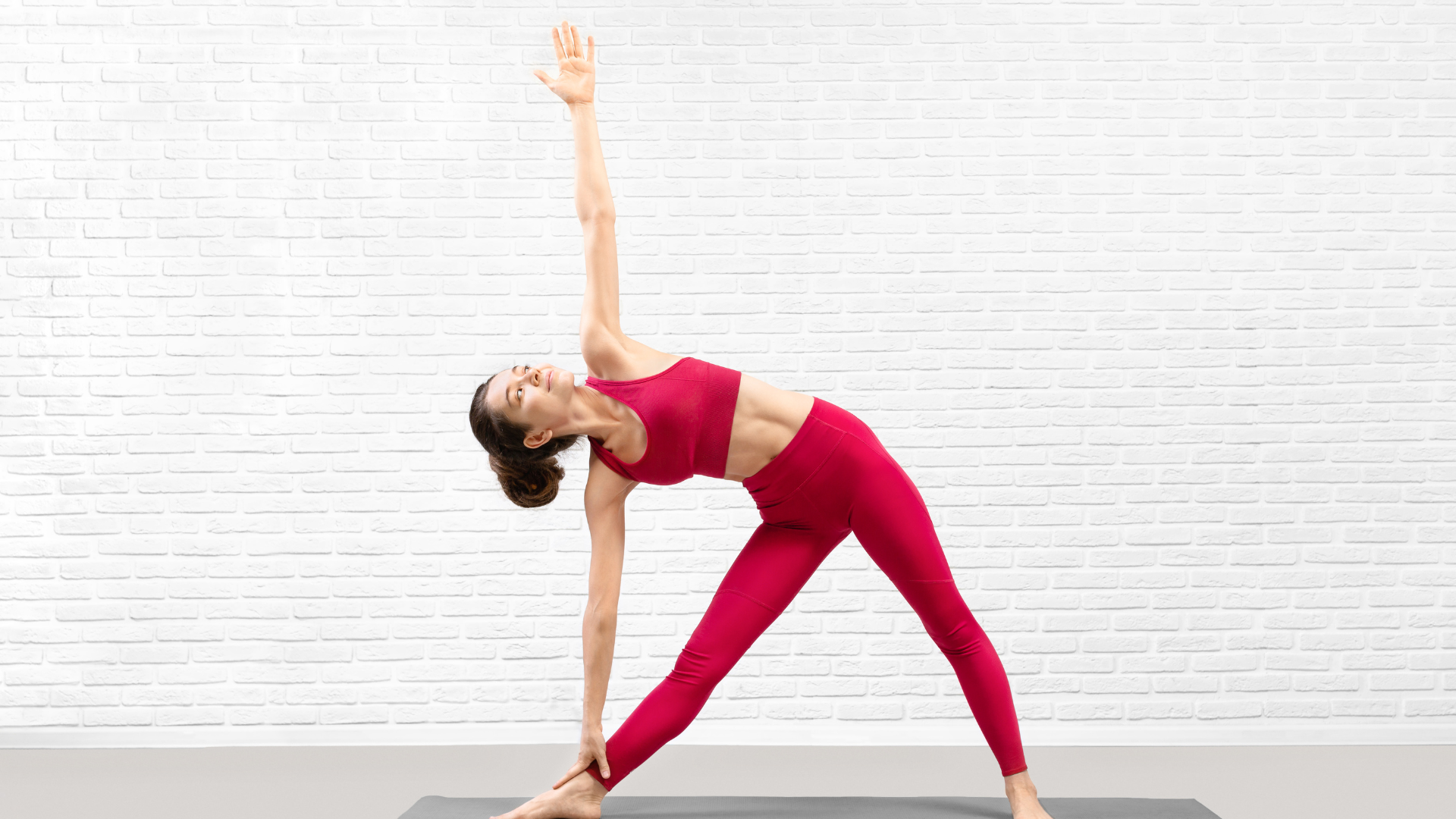
Foundation: Stand with your feet wide apart (about 3.5 to 4 feet). Turn your right foot out to 90 degrees and your left foot slightly inward.
Activation: Inhale and bring your arms parallel to the floor. Engage your thigh muscles (quadriceps) to protect the knee joints.
The Extension: Exhale and reach your torso over your right leg, hinging from the hip crease, not the waist. Keep both sides of your torso equally long.
The Placement: Bring your right hand down to your shin, a yoga block, or the floor (only if the spine remains straight). Reach the left arm toward the sky.
The Final Form: Turn your gaze toward the upper thumb. Hold for 5–10 deep breaths and repeat on the other side.
The Benefits for the Back
Quadratus Lumborum (QL) Release: The QL is a deep abdominal muscle that often becomes tight and causes lower back aches. Trikonasana provides a direct stretch to this area.
Hip Decompression: By opening the hip joints, the pose reduces the “pull” on the sacrum and lower spine.
Spinal Lateral Flexion: It maintains the health of the intervertebral discs by moving the spine in a lateral plane, which we rarely do in daily life.
The Contraindications
While highly beneficial, Trikonasana should be modified or avoided if you have:
Recent spinal or hip surgery.
Severe herniated discs (in the acute pain phase).
Low blood pressure or vertigo (keep the gaze forward instead of looking up).
Late-stage pregnancy (requires specific modifications with a wall or chair).
The Mechanics of Pain Relief: How it Works
How exactly does a standing triangle help a localized ache in the lumbar spine? The answer lies in the “Kinetic Chain.”
1. Releasing the Hamstring Tension
There is a direct link between tight hamstrings and lower back pain. When the hamstrings are short, they pull the pelvis into a posterior tilt (tucking the tailbone under). This flattens the natural curve of the lower back, leading to strain. Trikonasana provides an intense stretch to the hamstrings, allowing the pelvis to return to its natural, healthy alignment.
2. Strengthening the Core and Obliques
A “lazy” core is often the culprit behind back injuries. To hold Trikonasana correctly, you must engage the transverse abdominis and the obliques. This creates a “natural corset” around the spine, protecting it from sudden movements and providing the structural support necessary to alleviate pressure on the lower vertebrae.
3. Creating “Space” (Decompression)
One of the most common causes of lower back pain is the compression of the vertebrae due to gravity and poor posture. When you reach the crown of your head away from your tailbone in Triangle Pose, you are performing manual decompression. This creates a “vacuum” effect that can help improve circulation to the spinal discs.
Why Professional Guidance Matters
Many people try to learn Trikonasana via short social media clips, but for therapeutic results, precision is non-negotiable. Reaching too far down or allowing the chest to collapse forward can actually put more stress on the lower back.
At Patanjalee Shyambhai Yoga, we emphasize the use of props and micro-adjustments. Using a block under the hand, for example, allows the spine to remain perfectly straight, which is far more beneficial than touching the floor with a rounded back. This level of detail is a hallmark of our online yoga classes, where we bridge the gap between ancient technique and modern anatomical understanding.
Integrating Trikonasana into Your Daily Life
If you suffer from lower back pain, consistency is your most powerful ally. A single yoga session won’t undo years of sitting, but a daily practice of Trikonasana can rewire your musculoskeletal system.
Tips for a Pain-Free Practice:
Use a Wall: If your balance is shaky or your back is very stiff, practice Trikonasana with your heels and shoulder blades against a wall. This ensures your body stays in one plane.
Don’t Lock the Knees: Keep a “micro-bend” in the front knee. This ensures the muscles are doing the work, not the joints.
Breathe into the Ribs: Imagine your breath expanding the side of your body that is facing the ceiling. This deepens the stretch of the intercostal muscles and the deep fascia of the back.

A Holistic Transformation
While Trikonasana is a physical posture, its effects reach deeper. Lower back pain is often exacerbated by stress and the “fight or flight” response, which causes us to subconsciously tighten our pelvic floor and lower back muscles. The deep, rhythmic breathing required to hold a challenging standing pose like Triangle helps switch the nervous system into the “rest and digest” mode.
By calming the mind, we often find that the physical tension in the back begins to dissolve. This holistic approach—addressing the mind, the breath, and the bone—is what sets our method apart.
Conclusion
The geometry of the triangle is one of the strongest shapes in nature. By embodying this shape through Trikonasana, you lend that same strength and stability to your own spine. You move from a state of “collapsing” into your pain to “standing” in your strength.
If you are ready to move beyond the limitations of back pain, we invite you to explore a deeper practice. At Patanjalee Shyambhai Yoga, we provide the expertise needed to navigate your healing journey safely. Our online yoga classes are designed to meet you wherever you are—whether you are a complete beginner or looking to refine your alignment for therapeutic results.
Don’t let back pain define your lifestyle. Stand tall, reach wide, and find the space your body deserves through the power of the Triangle Pose. The path to a pain-free life is just one alignment away.